Continuity Editing
180 Degree Rule
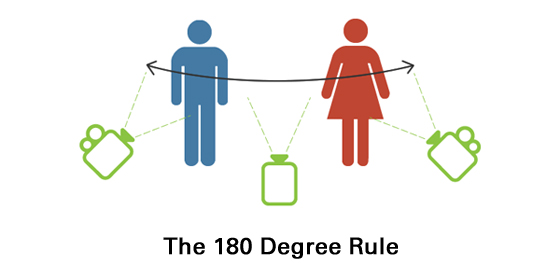
The 180 degree rule is used constantly within the film and television industry. It is a filming guideline that, participants in a scene should have the same left-right relationship to each other in order to allow the audience to have a greater sense of location in the scene in terms of what may be off-screen in some shots, for example in shot reverse shots. This rule is also used because it is believed to disorientate viewers if the 180 degree rule is broken. On the other hand it is also broken purposefully at times to confuse the audience.
Shot Reverse Shot
Shot reverse shot is a staple of editing in dialogue sequences. It utilizes the 180 degree rule, the eye line match and the rule of change among others. It is a film technique wherein one character is shown looking 'back' at the first character (usually within a conversation context). Since the characters are shown facing in opposite directions we as the audience are unconciously lead to believe that the characters are looking at each other. Obviously this is a very useful technique as we get to hear the dialogue whilst at the same time seeing the other persons reaction. This technique would be used frequently in soap dramas and perhaps powerful, emotional scenes in which the audience need to see how a certain characters react to different things.

Match On Action
A match on action or 'cutting on action' shot is an editing technique in which one shot cuts to another shot portraying the action of the subject in the first shot. This is used to create a sense of continuity so that the action carrying through creates a visual bridge which draws the viewers attention away from slight cutting and continuity issues. It portrays a continuous sense of the same action.


No comments:
Post a Comment